



If you’re evaluating datazone.de alternatives for a Central European enterprise, the short answer is: Collibra, Informatica, and Microsoft Purview lead for large-scale commercial deployments, while OpenMetadata, DataHub, and Apache Atlas cover EU-sovereign requirements that Amazon DataZone structurally cannot meet. AWS DataZone is absent from the AWS European Sovereign Cloud catalog, creating real GDPR Art. 30 exposure for organizations with strict data residency requirements.
The ten platforms most relevant to Central European enterprises right now:
- Collibra Platform — deep lineage, audit-ready workflows, strong GDPR policy automation
- Informatica Intelligent Data Management Cloud — automated lineage, multi-cloud, centralized policy enforcement
- Microsoft Purview Data Governance — native Azure integration, policy management built in
- Alation Intelligence Operating System — business glossary, collaborative stewardship, high adoption rates
- Atlan — user-friendly metadata management, fast onboarding for mixed technical and business teams
- Ab Initio — heavy-workload processing, enterprise lineage for complex data environments
- DataGalaxy Value Governance Platform — business-centric catalog, value-driven governance visualization
- Databricks — unified analytics and AI governance in one platform
- Egnyte — hybrid deployment, strong data privacy controls
- Domo — BI-integrated governance for analytics-first organizations
Selection hinges on three factors: EU regulatory coverage (GDPR, DORA, NIS2, EU AI Act), usability for both technical and business users, and whether your deployment model requires EU-sovereign infrastructure.
Best Amazon DataZone alternatives compared side by side
Every platform below is available in Central Europe. The comparison of core capabilities across use case, compliance, and metadata features is what separates them in practice.

| Platform | Best for | EU compliance | Usability for business users | Metadata management | Pricing/licensing |
|---|---|---|---|---|---|
| Ab Initio | Enterprise data integration and governance | GDPR lineage support | Technical-heavy | Deep lineage and processing | Enterprise contract |
| Alation Intelligence Operating System | Business user adoption and stewardship | GDPR-aligned catalog | High | Strong business glossary | Subscription, tiered |
| Informatica Intelligent Data Management Cloud | Cloud-oriented centralized governance | GDPR, multi-cloud policy | Moderate-high | Automated lineage, policy enforcement | Subscription, usage-based |
| Atlan | Collaborative data culture, mixed teams | GDPR metadata tagging | High | Integration-rich metadata | Subscription, tiered |
| Collibra Platform | Large enterprise audit readiness | GDPR, regulatory workflow automation | Moderate | Deep lineage, policy control | Enterprise contract |
| Microsoft Purview Data Governance | Microsoft Azure-centric enterprises | GDPR, Azure compliance | Moderate | Azure-native metadata | Azure consumption-based |
| DataGalaxy Value Governance Platform | Value-driven governance and collaboration | GDPR catalog | High | Business-centric visualization | Subscription |
| Databricks | Data engineering and AI governance | GDPR, Unity Catalog | Moderate | AI-driven metadata | Consumption-based |
| Egnyte | Hybrid deployment, data privacy | GDPR, HIPAA | Moderate | File-level governance | Subscription, tiered |
| Domo | BI-integrated governance | GDPR-aligned | High | Embedded BI metadata | Subscription |
| OpenMetadata | EU-sovereign open-source governance | GDPR, PII classification | Moderate | API-first, 60+ integrations | Open-source / managed |
| DataHub | Event-stream governance automation | GDPR workflow automation | Technical | Event-driven lineage | Open-source / managed |
| Apache Atlas | Scalable metadata with lineage focus | GDPR classification propagation | Technical | Classification propagation | Open-source |
| Secrato | DORA, NIS2, EU AI Act automation | DORA, NIS2, GDPR, CRA | Moderate | GRC-focused controls | Subscription |
| Adraca AI | Advanced EU compliance automation | EU AI Act, GDPR | Moderate | AI-enabled compliance | Subscription |
| SAS Information Governance | Hybrid deployments, data quality | GDPR, cloud-agnostic | Moderate | Deep data profiling | Enterprise license |
| Google BigQuery | Google Cloud analytics governance | GDPR, data residency options | Moderate | Warehouse-integrated governance | Consumption-based |
Collibra stands out for enterprises that need audit trails and regulatory workflow automation baked in. Its lineage depth and centralized policy management make it the default choice for compliance-heavy industries like banking and insurance across Central Europe.
Informatica covers multi-cloud environments well. Automated lineage and policy enforcement reduce manual governance overhead, which matters when your data spans AWS, Azure, and on-premises systems simultaneously.
Microsoft Purview is the obvious pick if your organization runs heavily on Azure. The integration is native, not bolted on, and the policy management layer ties directly into Azure Active Directory and data factory pipelines.
Alation and Atlan both prioritize business user adoption, which governance success ultimately depends on. Alation’s business glossary is particularly strong for organizations where data stewards and analysts need to collaborate without IT intermediation.
Databricks fits teams already running AI and data engineering workloads on the platform. Its Unity Catalog handles governance natively within the same environment, avoiding the overhead of a separate governance layer.
SAS Information Governance suits organizations that need cloud-agnostic deployment with serious data profiling capabilities. It runs on-premises, in private cloud, or in public cloud without architectural compromise.
Google BigQuery bundles governance directly into its data warehouse. For enterprises already in the Google Cloud ecosystem, the built-in access controls and data residency options make it a practical choice rather than a separate governance platform purchase.
How to choose the right Amazon DataZone alternative platform
Start with regulatory requirements, not features. Map your obligations under GDPR, DORA, NIS2, and the EU AI Act before opening any vendor demo. A platform that cannot automate your specific compliance workflows is a liability regardless of how good its catalog looks.
Key evaluation dimensions:
- Regulatory compliance mapping: Confirm the platform covers your specific frameworks. Secrato and Adraca AI automate DORA and NIS2 natively; Collibra and Informatica handle GDPR policy enforcement at scale.
- Usability for business and technical users: Governance programs fail on adoption, not policy gaps. Test the interface with actual data stewards, not just architects.
- Integration compatibility: Map your current stack (cloud warehouses, BI tools, orchestration frameworks) against vendor connector lists before shortlisting.
- Stewardship workflows: Task routing and approval workflows are non-negotiable in regulated environments. Metadata features alone do not satisfy compliance roles.
- Scalability: Centralized governance models work well initially but can struggle across jurisdictions as data volumes grow.
Pro Tip: Run your proof of concept on real, messy production data, not sanitized samples. Metadata sprawl happens when connectors fail against schema drift and legacy systems. A POC that passes on clean data and fails in production is worse than no POC at all.
Modular adoption consistently outperforms big-bang enterprise rollouts. Start with a high-impact domain, such as DORA compliance reporting, and expand from there. You get faster wins and better internal buy-in than attempting full-enterprise governance on day one.
EU-focused open-source and specialized governance platforms
For organizations where EU data sovereignty is a structural requirement, not just a preference, three open-source platforms deliver DataZone-equivalent functionality deployable entirely on EU infrastructure.
OpenMetadata provides data discovery across 60+ integrations, automated metadata ingestion, SQL-parsed lineage, and a PII classification framework. It deploys as a Docker Compose stack or on Kubernetes with Helm charts, with all storage running on infrastructure you control. No US-jurisdiction dependency.
DataHub takes a different approach. Its metadata change event stream triggers governance automation: a new dataset containing PII fields can automatically assign a data steward, request Art. 30 documentation, and block catalog publication until governance requirements are complete. This event-driven model enables GDPR-by-design workflows that managed cloud platforms cannot replicate. You can explore governance automation case studies to see how event-stream approaches perform in practice.
Apache Atlas handles GDPR classification propagation at scale. Tag a source table as containing special-category personal data and the tag propagates through all derived datasets automatically. The Art. 30 Record of Processing Activities can be built directly from Atlas’s entity and lineage graph via REST API, stored entirely on EU-sovereign infrastructure such as Hetzner, OVH, or IONOS.
Secrato and Adraca AI occupy a different category. Both are purpose-built GRC platforms that automate compliance for DORA, NIS2, and the EU AI Act more thoroughly than general data governance tools. Secrato keeps all compliance data within the EU and integrates with 20+ identity, cloud, and security platforms. These platforms work best alongside a data catalog rather than replacing one.
What implementation actually takes
Most enterprise governance platform deployments run several months from contract to production, depending on data estate complexity and integration scope. The first four weeks typically cover connector configuration and metadata ingestion setup. Weeks five through twelve focus on stewardship workflow configuration, business glossary population, and user training. Full policy enforcement and compliance reporting usually come online in the final phase.
Phased adoption shortens time-to-value considerably. Starting with one high-priority domain, such as DORA reporting or GDPR Art. 30 documentation, lets teams validate the platform against real requirements before expanding scope.
Total cost of ownership beyond the license fee
License costs are rarely the largest line item over a three-to-five-year horizon. TCO evaluation must include professional services for implementation, connector development for legacy systems, ongoing training, and support tier costs.
Open-source platforms like OpenMetadata, DataHub, and Apache Atlas carry no license fee but require engineering time for deployment, maintenance, and connector development. That cost is real and often underestimated. Commercial platforms like Collibra and Informatica include professional services and support in their contracts, which shifts cost structure but reduces internal engineering burden. For a regional deployment assessment covering open-source versus commercial TCO trade-offs, purpose-built audit tools can surface hidden cost drivers before you commit.
Hidden costs to budget for: schema drift remediation, metadata quality remediation after initial ingestion, user retraining after major platform updates, and compliance audit support when regulators request documentation.
Dasabo hosting supports your governance platform deployment
Data governance platforms need reliable infrastructure underneath them. Dasabo’s VPS and dedicated server hosting gives Central European enterprises a high-performance foundation for deploying OpenMetadata, DataHub, Apache Atlas, or any containerized governance stack, without the complexity of managing multi-cloud environments yourself.
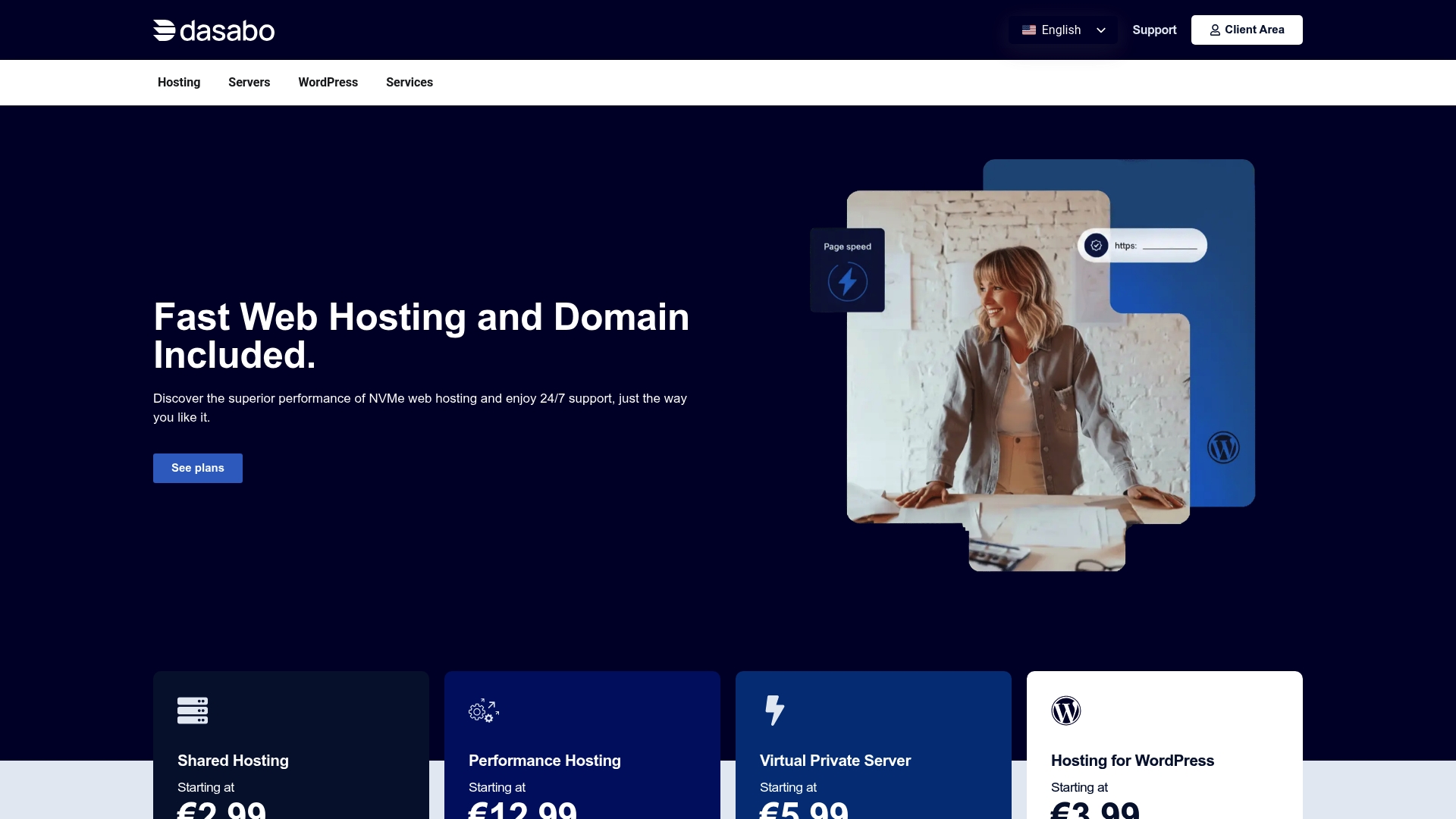
Dasabo runs NVMe SSD storage and LiteSpeed caching, which keeps governance dashboards and metadata queries fast under load. The 99.9% uptime guarantee and 24/7 support mean your compliance infrastructure stays available when auditors need it. With over 20,000 customers and 5,000 managed websites, Dasabo handles the infrastructure layer so your team can focus on governance configuration rather than server management.
Key Takeaways
The strongest Amazon DataZone alternatives for Central European enterprises combine EU regulatory automation, usable interfaces for business users, and deployment models that satisfy data sovereignty requirements.
| Point | Details |
|---|---|
| EU sovereignty drives platform choice | AWS DataZone lacks EU Sovereign Cloud support, making open-source alternatives on EU infrastructure a compliance requirement for many organizations. |
| Collibra and Informatica lead for large enterprises | Both offer deep lineage, policy enforcement, and audit-ready workflows suited to regulated Central European industries. |
| Adoption determines governance success | Platforms with intuitive interfaces for business users consistently outperform technically superior but hard-to-use alternatives in real deployments. |
| Modular rollout beats big-bang deployment | Starting with one high-impact domain shortens time-to-value and improves internal acceptance before full-enterprise expansion. |
| Dasabo provides the infrastructure layer | Dasabo’s VPS and dedicated hosting supports containerized governance platform deployments with NVMe SSD performance and 99.9% uptime. |