



The hosting features worth paying for come down to a short list: an SLA-backed uptime guarantee, low TTFB (time to first byte), free auto-renewing SSL, a Web Application Firewall (WAF) included by default, automated daily backups stored off-site, CDN integration, DDoS protection at the network edge, 24/7 support from actual engineers, scalable bandwidth, and a staging environment for safe deployments. These are not upsells. They are the baseline for any site that generates traffic, revenue, or trust in 2026.
Here is the short version of what you need before signing anything:
- SLA-backed uptime of 99.9% or higher with service credits, not just marketing copy
- low TTFB (time to first byte) (ideally under 400ms, with a 198ms median for top-ranking sites) for Core Web Vitals compliance
- Free auto-renewing SSL/TLS covering all subdomains, no manual renewal
- WAF blocking OWASP Top 10 threats included in the base plan
- Automated daily backups stored off-site, with 14–30 days of retention
- CDN integration built in or available as a one-click add-on
- DDoS mitigation at Layer 3/4/7, not just basic rate limiting
- Scalable or burstable bandwidth to survive traffic spikes without throttling
- 24/7 technical support from engineers who can fix infrastructure issues
- Staging environment to test changes before pushing them live
How hosting speed features affect your SEO and conversions
Server speed is not a technical detail you can defer. Even short delays in page load in page load can reduce conversions noticeably, and bounce rates increase significantly at five seconds of load time. Google’s Core Web Vitals use Largest Contentful Paint (LCP) as a direct ranking signal, and LCP is tightly linked to how fast your server responds.
The gap between hosting tiers is wider than most buyers expect. Budget shared hosting tends to have higher TTFB, while managed WordPress hosting tends to have lower TTFB. That difference shows up in your LCP scores, your rankings, and your revenue. The connection between hosting infrastructure and SEO is direct and measurable within 28 days of switching.
Server-level caching is where the real gains come from. LiteSpeed, NGINX FastCGI, and Redis object caching combined reduce database query overhead far more than any WordPress caching plugin can. Plugin-based caching works at the application layer. Server-level caching works before PHP even loads. CDN integration compounds these gains by serving static assets from edge nodes close to your visitors, cutting latency for anyone not sitting next to your data center.

Pro Tip: Check whether your host’s CDN is included or an add-on. Budget plans often require you to configure Cloudflare yourself, which is free but adds setup time and leaves the configuration entirely in your hands.
Uptime guarantees and support quality: what the SLA actually means
The word “guarantee” on a hosting sales page means nothing without a credit structure behind it. An SLA backed by service credits means the host pays you back when they miss the target. A marketing promise with no credit mechanism is just a number. Reputable hosts offer SLA-backed uptime of at least 99.9%, which translates to roughly 8.7 hours of allowable downtime per year. For an e-commerce site, every hour of downtime costs real money.
Support quality is the feature buyers most consistently underestimate. Scripted L1 support delays critical resolution during outages, which is exactly when you need someone who can fix an infrastructure-level problem, not read from a flowchart. Test support before you sign up: open a pre-sales chat and ask a specific technical question about server configuration. The answer tells you everything about what you will get at 2 AM when your site is down.
Scalable or burstable bandwidth belongs in the same conversation as uptime. Fixed bandwidth caps throttle or crash your site when traffic spikes unexpectedly. A Reddit mention, a newsletter feature, or a viral post can multiply your traffic overnight. Hosts with auto-scaling bandwidth handle that without you lifting a finger.
Questions to ask any host before committing:
- Is the uptime SLA backed by service credits, and where is that document?
- Are support agents engineers or L1 script readers?
- What happens to my site if I exceed bandwidth limits?
Choosing the right hosting architecture for your site
Picking the wrong hosting category before comparing providers is the most expensive mistake in hosting. The differences within a category are maybe 15% on price and performance. Across categories, they are 10x. Get the category right first.
Here is how the categories map to real site types:
- Shared hosting ($3–$15/month): Works for brochure sites and blogs under 20,000 monthly visitors. Avoid it if you process payments or store customer data.
- Managed WordPress ($25–$60/month): The right choice for WordPress sites that generate revenue. Includes server-level caching, automatic updates, daily backups, and staging.
- VPS/Cloud ($11–$100/month): For growing sites with 50,000–500,000 monthly visitors or custom stacks that need dedicated resources.
- Jamstack platforms (free–$20/month): Ideal for Next.js, Astro, and static sites. Global edge distribution by default.
- Enterprise cloud ($200+/month): Only when you have the engineering team to manage it or compliance demands it.
Upgrading from budget shared to managed hosting can deliver a strong ROI through improved Core Web Vitals, with an estimated organic traffic gain. For a site earning revenue from search, that math closes fast. Watch renewal pricing carefully: a introductory pricing that renews at a higher rate has a real three-year cost closer to $8–$10 per month, and that changes the comparison entirely.
Security features that prevent costly breaches
Security is where budget hosting hides its real cost. The $2.99/month plan almost always excludes the features that prevent a breach. You either pay for add-ons, doubling the price, or accept the risk until something breaks.
The non-negotiable security features for any production site:
- Free auto-renewing SSL/TLS: Paying extra for SSL in 2026 is avoidable and a red flag. Let’s Encrypt certificates are standard. Confirm wildcard coverage for subdomains and automatic renewal.
- WAF included by default: A WAF blocking OWASP Top 10 threats should come with the plan, not as a paid add-on. Budget hosts often leave WAF setup to you, which means Cloudflare or Sucuri configured manually.
- Automated daily backups with off-site storage: 14–30 days of retention is the minimum. Some hosts charge $25–$50 to restore from backups they advertise as free. Confirm one-click self-service restore is available.
- DDoS mitigation at the network edge: Ask specifically whether protection covers Layer 3/4/7 or just basic rate limiting.
- Two-factor authentication on the hosting panel: Prevents credential stuffing attacks on the account itself.
- Malware scanning: Daily scans included in the base plan, not an upsell.
The NVMe SSD storage question ties into security indirectly: faster storage means faster backup writes and faster restore times, which shortens your recovery window after an incident.
How Dasabo delivers on these standards for Central European websites
Dasabo was built around the exact checklist above. Every plan includes LiteSpeed caching and NVMe SSD storage, which together push response times below the 400ms TTFB threshold that separates competitive hosting from budget infrastructure. The hosting plans cover shared, VPS, and managed WordPress, so you can match the architecture to your site without switching providers as you grow.
Key features Dasabo includes as standard:
- 99.9% uptime SLA backed by a real credit structure, not a marketing promise
- LiteSpeed server-level caching combined with NVMe SSD storage for sub-400ms TTFB
- Global CDN integration for edge caching and reduced latency across Central Europe and beyond
- Automated daily backups with off-site storage and one-click restore
- WAF and DDoS protection included in the base plan, not sold separately
- 24/7 support from engineers who can resolve infrastructure-level problems
- Free auto-renewing SSL covering all domains and subdomains
Dasabo manages over 5,000 websites and has more than 20,000 satisfied customers, with a knowledge base and blog specifically oriented toward Central European website owners. The security architecture covers WAF, DDoS mitigation, and malware scanning without requiring third-party configuration. For developers and business owners who want expert advice on hosting strategy, Dasabo’s team provides personalized guidance rather than a generic support script.
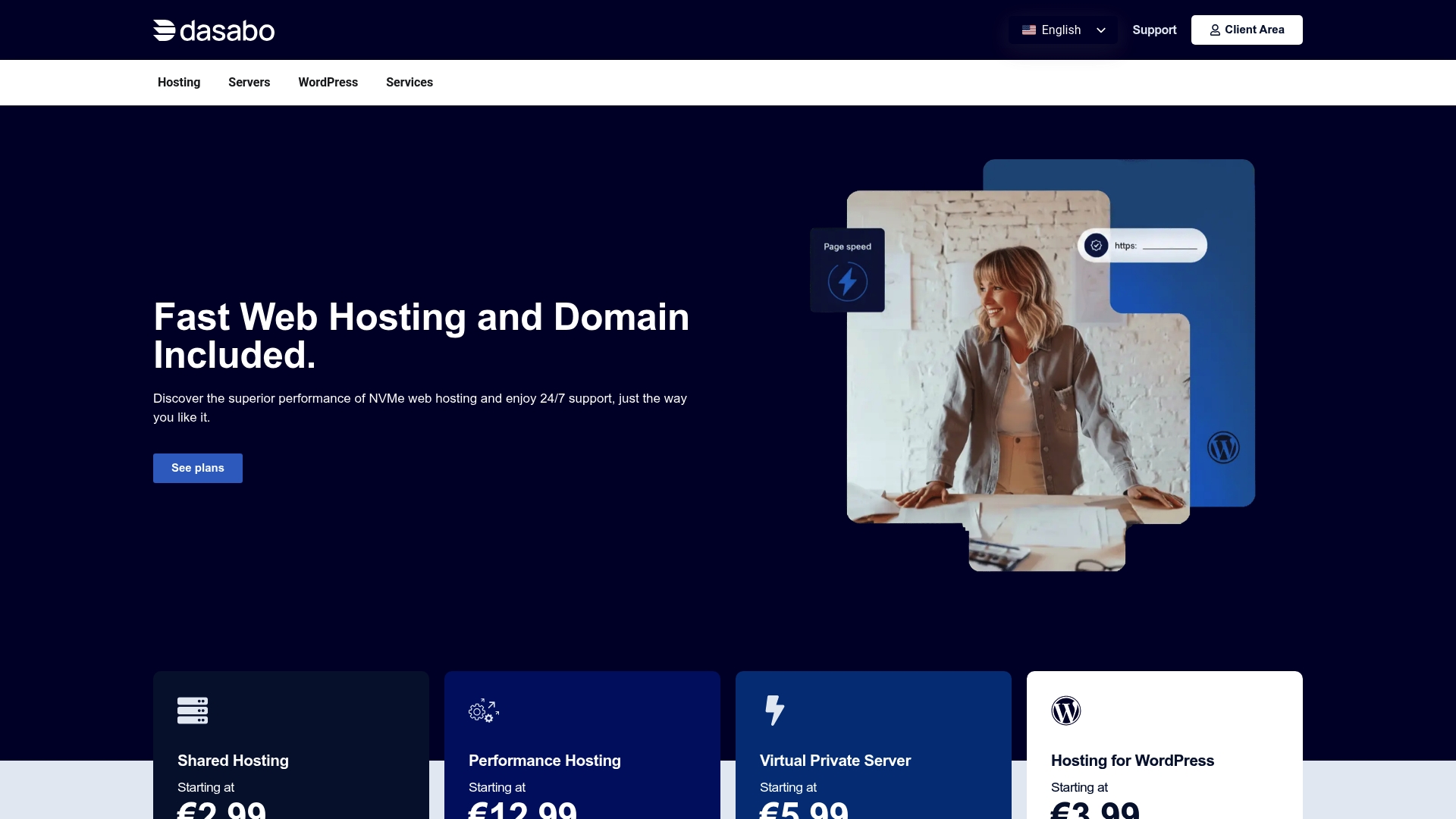
Start with the right infrastructure. Explore Dasabo’s hosting plans and find the tier that fits your site’s traffic, stack, and growth trajectory.
Why data center location matters for Central European sites
For visitors in Central Europe, a data center in Frankfurt, Vienna, or Warsaw delivers meaningfully lower latency than one in Virginia or Singapore. Physical distance between the server and the visitor adds round-trip time to every request, and that adds up directly in TTFB. A CDN reduces this for static assets, but your server’s origin location still determines how fast dynamic content loads, including database queries, personalized pages, and checkout flows.
When evaluating a host for a Central European audience, confirm the data center location explicitly. “European servers” can mean Amsterdam or Dublin, which adds 20–40ms compared to a Frankfurt or Vienna node for visitors in Poland, Czech Republic, Hungary, or Austria. For sites where most traffic comes from one country, a data center in or adjacent to that country outperforms a CDN-only solution for dynamic requests. The role of hosting location in SEO is also measurable: Google uses server location as a geotargeting signal when no country-code domain or Search Console setting is configured.
Dasabo operates infrastructure with Central European latency in mind, making it a practical choice for businesses whose customers are concentrated in this region.
Key Takeaways
The hosting features worth paying for in 2026 are those that directly protect uptime, speed, security, and your ability to recover fast when something goes wrong.
| Point | Details |
|---|---|
| SLA-backed uptime matters | A 99.9% uptime SLA with service credits is the minimum; marketing promises without credits mean nothing. |
| Speed drives revenue | Budget shared hosting tends to have higher TTFB; managed WordPress hosting tends to have lower TTFB, directly improving Core Web Vitals and rankings. |
| Architecture before price | Picking the wrong hosting category costs 10x more in performance and SEO penalties than the price difference between tiers. |
| Security is not an add-on | WAF, daily backups, and SSL should be included by default; budget plans that charge extra inflate your real total cost. |
| Data center location affects rankings | For Central European audiences, a nearby data center reduces latency on dynamic requests and supports geotargeting signals. |