




Hosting billing management is defined as an integrated software system that automates invoicing, payment collection, service provisioning, and customer account management for web hosting businesses. Unlike a standard invoicing app, it connects your sales process, payment gateway, and hosting control panel into one unified workflow. Website owners and administrators who run hosting operations quickly discover that manual billing creates errors, delays, and lost revenue. Understanding billing management at this level is the first step toward running a hosting business that scales without adding administrative overhead.
What is hosting billing management and what does it include?
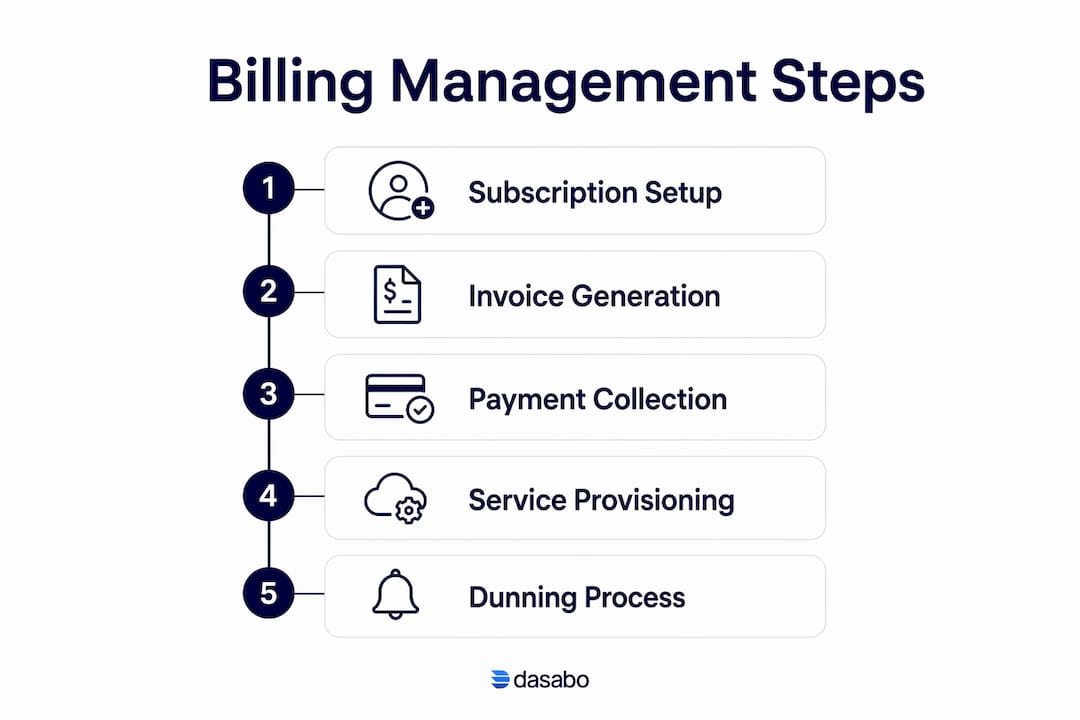
Hosting billing management consolidates five or more disconnected roles into a single platform: sales and order management, invoicing and payment processing, service provisioning, support ticketing, and customer records. That consolidation matters because each of those roles previously required a separate tool, and syncing data between them created constant errors and wasted hours.
The core components of a complete hosting billing system include:
- Sales and order management. Shopping cart flows and signup pages connect directly to billing, so a new customer order triggers an invoice automatically.
- Invoicing and payment processing. The system generates invoices, charges stored payment methods, applies taxes, and handles multiple currencies without manual input.
- Service provisioning. When payment clears, the system calls the hosting control panel via API to create the customer’s account instantly.
- Dunning management. Failed payments trigger automatic retries and escalating reminder emails before the system suspends service.
- Customer self-service portal. Customers log in to view invoices, update payment methods, and manage their own subscriptions.
Pro Tip: Set up your dunning sequence to send at least three reminder emails before suspending a customer’s account. Most failed payments are caused by expired cards, not intentional non-payment, and a short grace period recovers the majority of them.
The integration of sales, invoicing, and provisioning into one dashboard eliminates the need to manually sync data across a CRM, accounting software, control panel, and ticketing system. For a website administrator managing dozens of client accounts, that single dashboard is the difference between a manageable workload and a chaotic one.
How does billing automation improve efficiency and revenue?
Automation is the central value of any modern hosting invoicing solution. Recurring billing handles subscription renewals without any manual action, which means your revenue arrives on schedule whether you are in the office or not.

Proration is one of the most underappreciated automation features. When a customer upgrades their plan mid-cycle, the system calculates the exact credit for unused days and charges only the difference. Without automation, that calculation happens manually, and it often gets skipped entirely, which costs the provider money.
Multi-currency support and automatic tax calculations address a real operational problem for hosting providers with international clients. A customer in Germany expects a euro invoice with VAT applied correctly. A customer in Canada expects GST. Effective billing systems handle complex pricing, multi-currency, and regional tax calculations without requiring the administrator to configure each invoice manually.
The revenue impact of automation shows up most clearly in payment recovery. Automated dunning management reduces churn by 10–20% by recovering failed payments before service suspension occurs. That range represents real customers who would have churned not because they wanted to leave, but because their card expired and no one followed up.
The operational benefits stack up in a clear sequence:
- Recurring billing fires automatically on the renewal date, with no manual invoice creation required.
- Payment fails. The dunning system retries the charge and sends a reminder email within 24 hours.
- Second retry and escalated reminder go out three days later if the first attempt did not succeed.
- Service suspends automatically only after the grace period expires, giving the customer time to update their payment method.
- Service resumes instantly once payment clears, with no administrator involvement needed.
Self-service customer portals reduce support requests by 30–50% by letting customers handle common billing tasks on their own. That reduction directly lowers your support overhead and frees your team to focus on technical issues that actually require human attention.
How does hosting billing software differ from generic billing apps?
Generic billing software handles invoices and payments. Hosting billing software does that and also controls your hosting infrastructure. That distinction is not minor. It is the entire reason a specialized category exists.
The critical differentiator is API-driven provisioning, which connects the billing system directly to hosting control panels like cPanel or Plesk. When a customer pays, the API call creates their hosting account automatically. When a customer cancels, the API call terminates it. No administrator needs to log into the control panel manually.
Generic invoicing apps offer none of that. They record a payment and stop there. The administrator still has to open the control panel, create the account, set the resource limits, and configure the domain. For a provider managing ten clients, that is manageable. For a provider managing two hundred clients, it is a full-time job.
The table below shows where the two categories diverge on the features that matter most to hosting administrators:
| Feature category | Generic billing app | Hosting billing system |
|---|---|---|
| Automated invoicing | Yes | Yes |
| Recurring subscription billing | Limited | Full support |
| Control panel API provisioning | No | Yes (cPanel, Plesk) |
| Domain and SSL provisioning | No | Yes |
| Dunning and payment recovery | Basic | Automated sequences |
| Customer self-service portal | Rarely | Standard feature |
| Multi-currency and tax automation | Sometimes | Built in |
Domain management and SSL provisioning are two additional areas where hosting billing systems go beyond generic tools. A customer who purchases a domain through your store expects it to register automatically. A customer who orders an SSL certificate expects it to install without waiting for a support ticket. Billing software that talks to control panels via API handles both of those workflows without manual steps.
How to choose the right hosting billing system for your business
The right billing system depends on your scale, your technical resources, and the complexity of your pricing model. A provider managing ten client websites has different needs than one managing a thousand.
For smaller hosting operations, lighter SaaS-based billing tools handle invoicing and subscription billing efficiently without the complexity of traditional hosting-focused platforms. These tools cost less, require no server setup, and cover the core needs: automated invoicing, recurring billing, and a customer portal.
For larger operations or reseller hosting businesses, a full hosting billing platform with API provisioning becomes necessary. The key factors to evaluate are:
- API provisioning support. Confirm the system integrates with your specific control panel, whether that is cPanel, Plesk, or another platform.
- Automation depth. Check whether dunning, proration, and service suspension are fully automated or require manual triggers.
- Customer portal quality. A self-service portal that customers actually use reduces your support volume. Test it before committing.
- Multi-currency and tax compliance. If you serve international clients, this is non-negotiable. Verify it handles the specific tax rules for your key markets.
- Scalability. The system should handle your current client count and your projected count two years from now without a platform migration.
Pro Tip: Avoid choosing a platform based on its feature list alone. Run a test provisioning cycle from signup to account creation before you commit. If that workflow has friction, your customers will feel it every time they sign up.
Billing management tracks subscription changes, usage, and payment history over the full customer lifecycle, not just at the point of sale. That relational view of billing is what separates a system built for hosting from one built for one-time transactions. Choose a system that treats each customer as an ongoing relationship, not a single invoice.
Key Takeaways
Hosting billing management is the operational foundation that connects payment collection, service provisioning, and customer management into one automated system for hosting businesses.
| Point | Details |
|---|---|
| Unified platform replaces five tools | Hosting billing software consolidates CRM, invoicing, provisioning, ticketing, and customer records into one system. |
| API provisioning is the key differentiator | Control panel API integration automates account creation and suspension, which generic billing apps cannot do. |
| Dunning management protects revenue | Automated payment recovery sequences reduce involuntary churn by 10–20% before service suspension occurs. |
| Self-service portals cut support volume | Customer portals that handle billing tasks independently reduce support requests by 30–50%. |
| Match system complexity to business size | Smaller providers benefit from lightweight SaaS billing tools; larger operations need full API provisioning platforms. |
Why billing management is the part most hosting businesses get wrong
Alex here. After watching hosting operations at various scales, the pattern I see most often is this: a provider invests heavily in server infrastructure and almost nothing in billing infrastructure. They use a generic invoicing app, handle provisioning manually, and wonder why their support queue is full of “my account isn’t active yet” tickets.
The uncomfortable truth is that your billing system is your customer’s first real experience with your business. The signup flow, the invoice, the payment confirmation, the account activation. All of that happens before they ever log into their hosting control panel. If any step in that chain requires manual intervention, you have already introduced a delay and a potential failure point.
Dunning management is the most neglected piece. Providers set up automated invoicing and feel like they are done. But failed payments are inevitable, and without an automated recovery sequence, each one becomes a manual task or a lost customer. The self-service portal is the second most neglected piece. Customers who can update their own payment method at 11:00 PM do not need to open a support ticket. That is support volume you never have to handle.
My honest recommendation: treat your billing system as core infrastructure, not an afterthought. Evaluate it with the same rigor you apply to your hosting hardware. The reseller hosting providers I have seen grow fastest are the ones who automated billing early and stopped touching it manually.
— Alex
Dasabo hosting with billing built for real operations
Dasabo offers hosting plans across shared, VPS, and managed WordPress environments, each designed to work with professional billing and provisioning workflows from day one.
Dasabo manages over 5,000 websites and serves more than 20,000 customers, with a 99.9% uptime guarantee backed by NVMe SSD storage and LiteSpeed caching. That infrastructure pairs directly with the kind of billing automation this article covers. Whether you need shared hosting for a growing client base or a dedicated environment for high-traffic sites, Dasabo gives you the hosting foundation that professional billing management is built on. Explore Dasabo’s hosting options and see which plan fits your operation.
FAQ
What is hosting billing management in simple terms?
Hosting billing management is software that automates invoicing, payment collection, and hosting account provisioning in one system. It replaces the need to manage separate tools for CRM, accounting, and control panel administration.
How does hosting billing software differ from standard invoicing tools?
Hosting billing software connects to control panels like cPanel or Plesk via API to automate account creation and suspension based on payment status. Standard invoicing tools record payments but cannot trigger any hosting infrastructure actions.
What is dunning management in a billing system?
Dunning management is the automated process of retrying failed payments and sending escalating reminder emails before suspending a customer’s service. It reduces involuntary churn by 10–20% by recovering payments that fail due to expired cards or temporary issues.
Do small hosting providers need specialized billing software?
Smaller hosting providers can manage invoicing and subscriptions effectively with lightweight SaaS billing tools that do not require complex setup. Full hosting billing platforms with API provisioning become necessary as client volume and pricing complexity grow.
How do self-service billing portals help hosting administrators?
Self-service portals let customers view invoices, update payment methods, and manage subscriptions without contacting support. This reduces support request volume by 30–50%, freeing administrators to focus on technical issues.