




Round-the-clock expert technical support is the defining function of 24/7 support hosting. It keeps your website online, fast, and secure at any hour, not just during business hours. For small business owners and e-commerce operators, this distinction matters more than almost any other hosting feature. A 1-second page load delay increases bounce rates by up to 32%, and 40% of visitors abandon sites that take longer than 3 seconds to load. Without expert support available at 2:00 AM on a Sunday, those visitors are gone before you even know there is a problem.
What is the role of 24/7 support hosting for websites?
Always-on hosting support is the practice of providing continuous, expert-level technical assistance to keep websites running without interruption. The industry standard for this service is defined by Service Level Agreements, or SLAs, which set minimum uptime guarantees and maximum response times. Dasabo, for example, backs its hosting plans with a 99.9% uptime guarantee, which translates to fewer than 9 hours of potential downtime per year.
The role of 24/7 support hosting goes well beyond answering tickets. Expert support teams handle server configuration, backend performance tuning, caching setup, and security patching. These tasks prevent problems from developing rather than just fixing them after the fact. For a small business without an in-house IT team, this is the equivalent of having a full technical department on call at all times.

A 100-millisecond delay in server response produces a measurable increase in bounce rates. That figure puts the stakes in sharp focus. Even minor, unresolved server issues translate directly into lost visitors and lost revenue.
How does 24/7 support impact website performance and uptime?
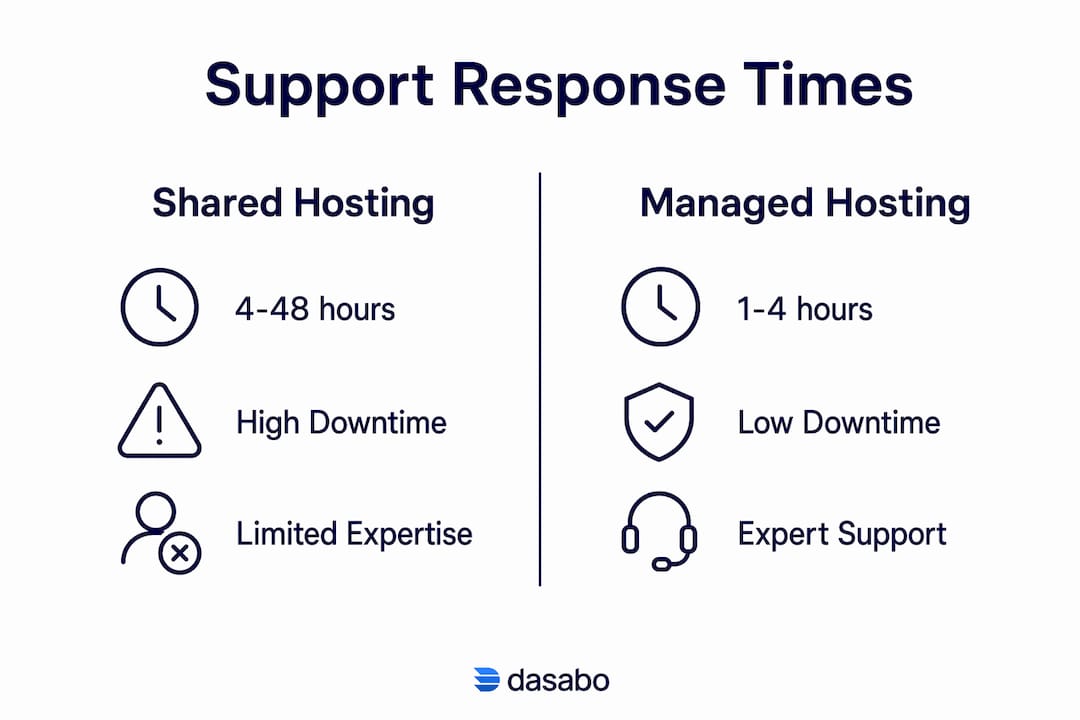
The speed of support response determines how long a problem lasts. Shared hosting tickets are typically resolved in 4–48 hours, while managed enterprise hosting resolves issues in 1–4 hours. That gap is the difference between a brief hiccup and a full business day of downtime.
The practical impact is significant. A 4-hour outage during a flash sale costs a fraction of what a 48-hour outage costs. Customer trust erodes with every hour a site is unavailable. Repeat visitors who encounter errors rarely return.
Expert support teams also perform proactive work that prevents outages entirely. Managed hosting support covers ongoing updates, backups, and backend optimizations that catch problems before they escalate. This is the difference between reactive and preventive hosting management.
Pro Tip: Ask your hosting provider how long their median ticket resolution time is, not just their first-response time. First response from a chatbot is not the same as a resolved issue.
| Hosting tier | Typical response time | Downtime risk |
|---|---|---|
| Shared hosting | 4–48 hours | High during off-peak hours |
| VPS hosting | 2–12 hours | Moderate with basic support |
| Managed hosting | 1–4 hours | Low with proactive monitoring |
| Dedicated servers | Under 1 hour | Lowest with dedicated support staff |
Fast response times also protect your search rankings. Backend tuning and caching configuration improve core web vitals, which Google uses as direct ranking signals. A support team that actively tunes your server is also, indirectly, improving your SEO.
Why do small businesses need real expert support, not just tier-1 help?
Many hosting providers advertise 24/7 support but deliver something far more limited. First-tier support agents are often non-technical and rely on scripts. They can reset passwords and restart services, but they cannot diagnose a PHP memory leak or reconfigure a web server. Getting to a real engineer often requires escalation, which adds hours to resolution time.
Small businesses are especially vulnerable to this gap. Without internal IT staff, you depend entirely on your hosting provider when something breaks. If that provider’s “24/7 support” is a chatbot from midnight to 6:00 AM, your site may stay down until business hours.
The risks of inadequate support are concrete:
- Revenue loss during off-hours outages. E-commerce sites process orders around the clock. A 3:00 AM server crash with no expert available means lost sales until morning.
- Security vulnerabilities left unpatched. Delayed support on a security incident gives attackers more time to cause damage.
- Slow escalation chains. Tier-1 agents who cannot resolve issues must escalate, adding 30–90 minutes before a qualified engineer even sees the problem.
- Missed performance optimizations. Non-technical agents cannot tune caching, configure LiteSpeed, or audit database queries.
Pro Tip: Test your hosting provider’s support quality before you commit. Contact them at 11:00 PM on a weekday with a technical question and measure both response time and the depth of the answer.
Verified expert support access is a critical factor when selecting managed hosting. The best providers give you direct access to engineers, not just a support queue. Dasabo’s support model is built around this principle, connecting customers to technical staff rather than routing every issue through non-technical triage.
What are the key benefits of 24/7 support hosting for e-commerce operators?
E-commerce businesses operate across time zones and peak sales periods that do not align with a 9-to-5 schedule. The benefits of round-the-clock support are most visible during these high-stakes moments.
- Protecting revenue during peak periods. A checkout error during Black Friday or a product launch can cost thousands of dollars per hour. Expert support that resolves the issue in minutes instead of hours directly protects that revenue.
- Maintaining customer trust. Shoppers who encounter errors during checkout rarely try again. Consistent site availability, backed by fast issue resolution, keeps conversion rates stable.
- Securing transaction data. E-commerce sites handle payment information and personal data. Proactive security management, including updates and monitoring, reduces the risk of breaches that destroy customer confidence.
- Supporting global operations. A business serving customers in Europe and Asia needs its site available at hours when American support teams are offline. True 24/7 coverage closes that gap.
Hosting plans with live chat and phone support resolve complex issues faster than ticket-only systems. For e-commerce operators, this speed difference is a direct business advantage. A 10-minute live chat resolution beats a 6-hour ticket queue every time.
The impact of continual support also extends to site performance. Faster load times, driven by expert backend tuning, boost SEO and conversions simultaneously. A well-supported site is not just more reliable. It is also more profitable.
How do support response times compare across hosting tiers?
Choosing a hosting plan based on price alone is a common mistake for small businesses. The support quality embedded in each tier varies dramatically, and that variation has real consequences.
Shared hosting is the most affordable option, but its support model reflects that price. Tickets enter a shared queue, and resolution times of 4–48 hours are standard. For a personal blog, this is acceptable. For an e-commerce store, it is a serious risk.
VPS hosting offers more control and typically faster support, but the quality depends heavily on whether the plan is managed or unmanaged. Unmanaged VPS plans often provide minimal support, leaving server administration entirely to the customer.
Managed hosting, including managed WordPress hosting, is where always-on hosting solutions deliver their full value. Support teams handle updates, backups, and performance tuning as part of the service. The difference in response time between managed and shared hosting can mean 4 hours of downtime versus 48 hours. That gap directly affects business operations and revenue.
| Criteria | Shared hosting | Managed hosting | Dedicated server |
|---|---|---|---|
| Response time | 4–48 hours | 1–4 hours | Under 1 hour |
| Expert access | Tier-1 only | Engineers available | Dedicated team |
| Proactive maintenance | Rare | Standard | Fully customized |
| Best for | Personal sites | Small to mid businesses | High-traffic operations |
| Support channels | Ticket only | Chat, ticket, phone | All channels plus account manager |
Dedicated server hosting provides the fastest and most personalized support, with dedicated teams and SLAs that guarantee response times. This tier suits high-traffic businesses where downtime costs are severe. For most small businesses, managed hosting hits the right balance between cost and support quality.
The small business hosting guide from Dasabo covers how to evaluate these tiers against your specific traffic patterns and risk tolerance. Matching your hosting tier to your actual support needs is the most practical decision you can make.
Key Takeaways
Reliable 24/7 expert hosting support is the single most important factor separating hosting plans that protect your business from those that merely host your files.
| Point | Details |
|---|---|
| Response time determines downtime length | Managed hosting resolves issues in 1–4 hours vs. 4–48 hours for shared hosting. |
| Expert access beats tier-1 chatbots | Real engineers resolve complex issues that scripted agents cannot touch. |
| Proactive support prevents outages | Ongoing updates, backups, and tuning stop problems before they affect visitors. |
| E-commerce needs off-hours coverage | Peak sales and global time zones require support that does not clock out at 5:00 PM. |
| Test support before you commit | Contact providers at off-peak hours to verify actual response quality and speed. |
What I have learned about 24/7 support hosting after years of watching businesses get it wrong
The most expensive mistake I see small business owners make is treating hosting support as a checkbox. They see “24/7 support” in the feature list and assume it means a qualified engineer is one chat message away at any hour. It rarely does.
I have watched e-commerce stores lose entire weekend sales because their hosting provider’s overnight support team could not escalate a database error until Monday morning. The financial damage was real. The brand damage lasted longer.
The providers worth trusting are the ones who can answer a technical question at midnight without routing you through three levels of scripted responses first. Before signing any hosting contract, I recommend sending a genuinely technical question through their support channel at 10:00 PM. The quality and speed of that response tells you everything about what you will get during an actual crisis.
The other thing most articles miss is the compounding value of proactive support. Expert teams that tune your caching, audit your database queries, and monitor your core web vitals are not just preventing downtime. They are actively making your site faster and more competitive every month. That ongoing work is worth more than any emergency response, because it means fewer emergencies in the first place.
My advice is direct: do not buy hosting based on price and storage. Buy it based on who picks up the phone at 2:00 AM and what they can actually do when they get there.
— Alex
Dasabo’s approach to always-on expert hosting support
Dasabo’s hosting plans are built around the reality that small businesses cannot afford to wait 48 hours for a server fix.
Dasabo provides genuine 24/7 technical assistance through real support staff, not just automated triage. Every plan includes proactive maintenance, security updates, and performance monitoring. Managed WordPress hosting from Dasabo covers backups, updates, and backend tuning as standard features, not add-ons. With a 99.9% uptime guarantee and over 20,000 satisfied customers, Dasabo’s hosting plans are designed for businesses where downtime is not an option. If you are ready to move to a provider that answers technical questions at any hour, Dasabo is worth a close look.
FAQ
What does 24/7 support hosting actually mean?
24/7 support hosting means expert technical assistance is available every hour of every day, including nights, weekends, and holidays. The key distinction is whether that support includes qualified engineers or only tier-1 agents following scripts.
How much does slow hosting support cost a small business?
The cost depends on traffic and sales volume, but the response time gap between shared and managed hosting can mean 4 hours of downtime versus 48 hours. For an e-commerce store, that difference can represent a full day of lost revenue.
How do I verify that a hosting provider’s 24/7 support is genuine?
Contact the provider’s support channel with a specific technical question at an off-peak hour, such as late evening or early morning. Measure both the response time and whether the answer reflects real technical knowledge.
What is the difference between managed and shared hosting support?
Shared hosting typically routes tickets through a general queue with 4–48 hour resolution times. Managed hosting provides access to engineers who handle proactive maintenance, updates, and faster resolution, typically within 1–4 hours.
Why does hosting support quality affect SEO?
Expert support teams perform backend tuning and caching configuration that improve core web vitals. Google uses core web vitals as ranking signals, so a well-supported, faster site ranks higher and retains more visitors than a slow or unreliable one.